
Right Rate, Lower Cost
With clean seed in the bins and thawing temperatures exposing more dirt in the fields, it’s hard not to start thinking about seeding. Wheat is often one of the first products to move each spring, and it always gets me looking through our seed lots and seed sizes to see what it will take to achieve that ideal plant stand, and maybe even save a bit on certified seed costs.
The soybean industry has done an excellent job educating growers about targeting ideal plant stands by focusing on seed size. Wheat should be no different. While wheat seed may not carry the same cost as soybeans, targeting your plant stand using TKW (thousand kernel weight) allows you to compare varieties more accurately and avoid excessively thick stands.
Before getting into some numbers, it’s worth highlighting why this is becoming more important than ever. Wheat genetics have made huge strides in the last five years. In my opinion, much of this progress comes from varieties now being registered from multiple breeding programs.
For example, AAC Westking comes from Agriculture and Agri-Food Canada, with AAC Brandon used as a parent to focus on strong quality and plump kernels. On the other hand, varieties like SY Manness come from Syngenta’s breeding program, where breeders may emphasize different plant and seed characteristics. As we continue to evaluate new genetics, we’re even seeing varieties with different tillering habits, some averaging one less head per plant, which may require different optimal plant stands.
This diversity in genetics is creating new opportunities for growers to diversify their wheat acres.
Let’s look at an example using two varieties we currently have in the yard:
SY Manness
TKW: 30.3 g
Germination: 99%
AAC Westking
TKW: 41.8 g
Germination: 99%
Using these numbers, we can calculate seeding rates targeting plant stands between 28–40 plants per square foot, assuming 10% mortality.
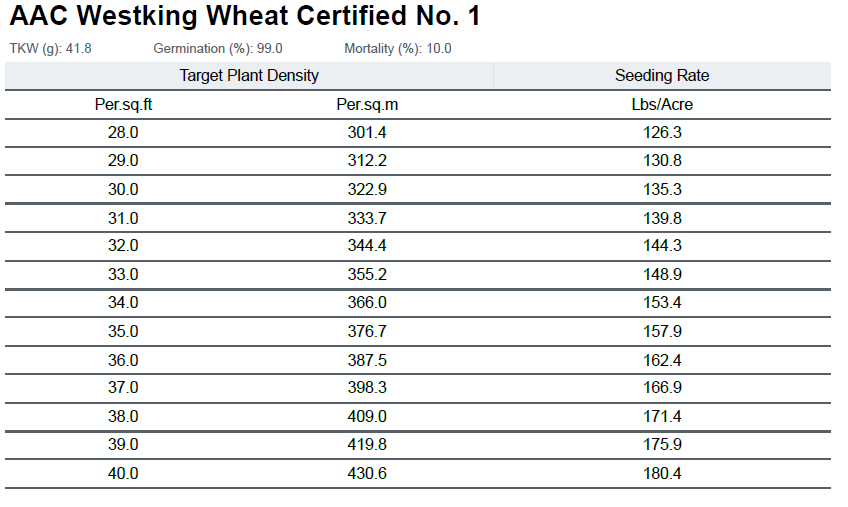
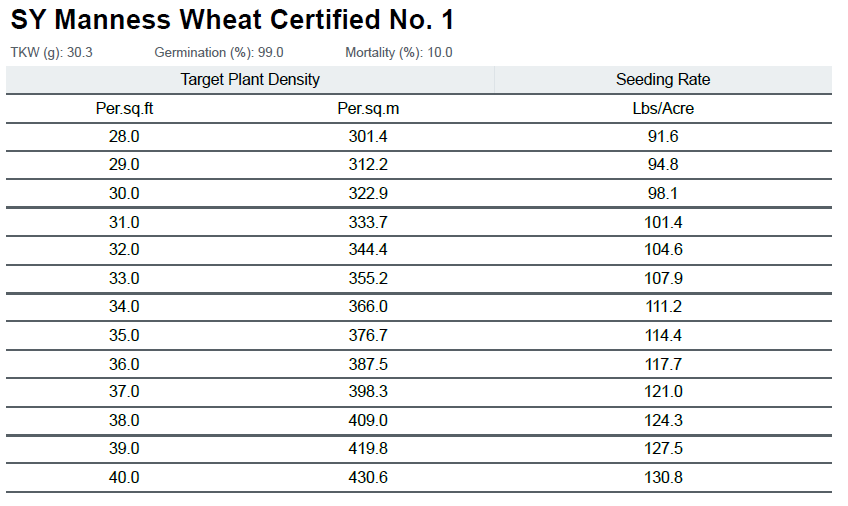
If we seed both varieties at the traditional 2.25 bu/ac (135 lbs/ac) rate many of us grew up with, we would end up with roughly:
• 40+ plants/sqft in the SY Manness field
• 30 plants/sqft in the AAC Westking field
That 10-plant difference might not sound like much, but depending on fertility, growing conditions, and management practices, it can certainly influence the final result. Thicker stands behave differently than thinner ones when it comes to yield potential, standability, and plant height. It also makes side-by-side variety comparisons much harder to interpret.
Manitoba Agriculture recommends targeting 24–28 plants per square foot for spring wheat. In the case of SY Manness, our standard 2.25 bu/ac rate puts us well above that recommendation.
If we instead target 28 plants/sqft, the required rates would be approximately:
• SY Manness: 92 lbs/ac (1.55 bu/ac)
• AAC Westking: 126 lbs/ac (2.1 bu/ac)
Of course, field conditions, seedbed preparation, and seeding equipment should all be considered before lowering rates, as these factors can influence seedling mortality.
As with most things in agronomy, there’s always a caveat: not every seed lot is the same. Each year we see variability in seed size, and even between varieties the difference can be significant. In this example, over 33%.
So, is a seed salesman telling you to buy less seed?
The answer is: it depends.
With new genetics entering the marketplace, there’s always a conversation worth having. Ask us about the variety you’re purchasing and the TKW of the specific lot, so we can help target the optimal plant stand instead of relying on a “standard” wheat seeding rate.
~Jacques Remillard