
After the Application: Lessons learned from our first season of Canola Seedpod Weevil
If you ended up having to spray for Canola Seedpod Weevil (CSPW) for the first time this season, you are not alone. Manitoba Entomologist John Gavolski confirmed what felt like a dramatic exponential spread this season from years past.
Seedpod weevil has been on our radar, however last year was really the first of economic thresholds being reached here in Manitoba. Even then, only a few fields in the province required an application. This year was a bit of a different story. Agronomists across the province reported high sweeps, particularly in the first flowering fields of a region. In many fields, we observed numbers into the economic threshold of 25 to 40+ per 10 sweeps, and an application was made. This included our own canola fields here at Pitura Seeds Farm.
The Application is only part of the Canola Seedpod Weevil Story
When canola seedpod weevil shows up in a field, the immediate focus is on the management decision: Are populations high enough to warrant control? Is the crop at the right stage? And, if an application is made, was it timed effectively? But once the sprayer has left the field, our learning and understanding doesn’t stop.
What did we see in the pods? Did the level of adult activity we observed translate into meaningful damage? Did our management decisions line up with what we ultimately found in the crop? Possibly most importantly, what can we take from this season before we head into the next one?
Following up after this newly emerged pest gives us an opportunity to reflect on both this year's management decisions, but also learn more for seasons ahead. Here’s a few of the key takeaways we have after spraying for CSPW in 2026:
Lesson 1: Count every field – Populations can vary dramatically based on flowering timing.
Weevils are attracted to bright flowering canola fields, and populations surge in those first flowering fields. Research has shown that the earliest seeded, or first flowering fields, will see the highest population of weevils - and can greatly drop off to near zero in the fields to follow.
Our team, along with many other agronomists across the province, were able to witness this significant drop. In some cases, just a few days difference in flowering timing were the difference between well above threshold, and a near-zero count.
This year was particularly challenging. With lots of moisture around flowering timing, many acres required an application by air – combined with considerable concern surrounding this emerging threat. Time was tight, and nerves were unsettled. As a result, there were likely fields where an application was made as a precaution.
But because of this wild swing in population levels, it is important that we complete a sweep for each individual field and make application decisions on a field-by-field basis. Gavloski notes that even when time is tight, completing just even four different sweeps, in a couple different areas of the field, can provide a useful indication of population levels. Both for economic and environmental reasons, treating each field individually is critical!
Lesson 2: Pollinators do provide a yield boost – protect them where we can
An application to protect against canola seedpod weevil comes with some consequences. Because control requires an application during flowering timing, with a broad spectrum insecticide, this can lead to a significant reduction in beneficials and pollinators. Pollinators do provide a yield boost, Gavloski states research shows a 10-15% yield boost from these insects. This means that in fields that have not actually reached the economic threshold, we could inadvertently be decreasing our yield potential by removing those pollinators. This is another reason why accurate field-by-field scouting and making applications only when necessary will be important as we continue to manage CSPW.
Lesson 3: Following up now to observe pod damage, and timing of application
Regardless of whether an application was made, now might be a perfect time to take a walk through and look for signs of CSPW. In fields with higher pressure that did not receive an application, we are noticing plants that are showing signs of damage throughout the canopy. As a reminder and follow up to Andrew’s previous article on seedpod weevil – the egg is laid in the pod when the first few pod’s of the plant are about 1” long. The egg hatches a few days later, feeds on 5-6 seeds in the pod over the course of a couple weeks, then chews an exit hole in the pod and drops to the ground.
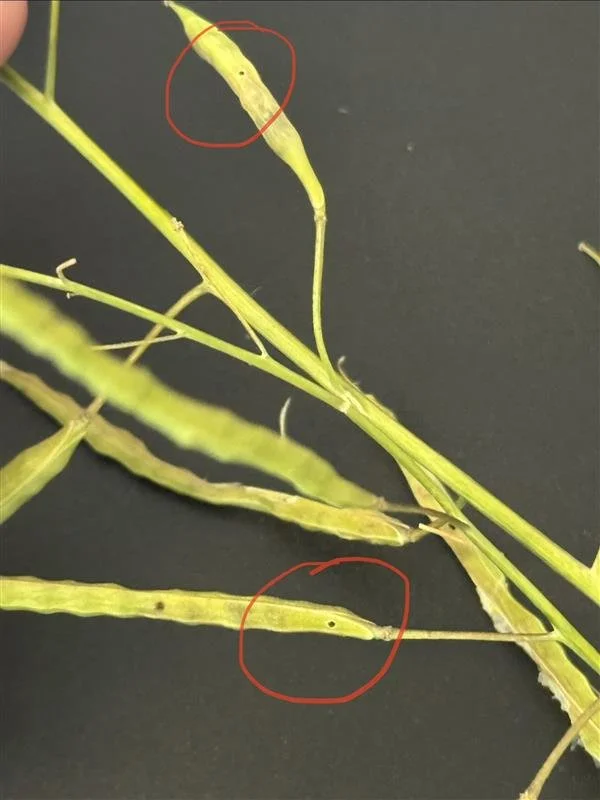
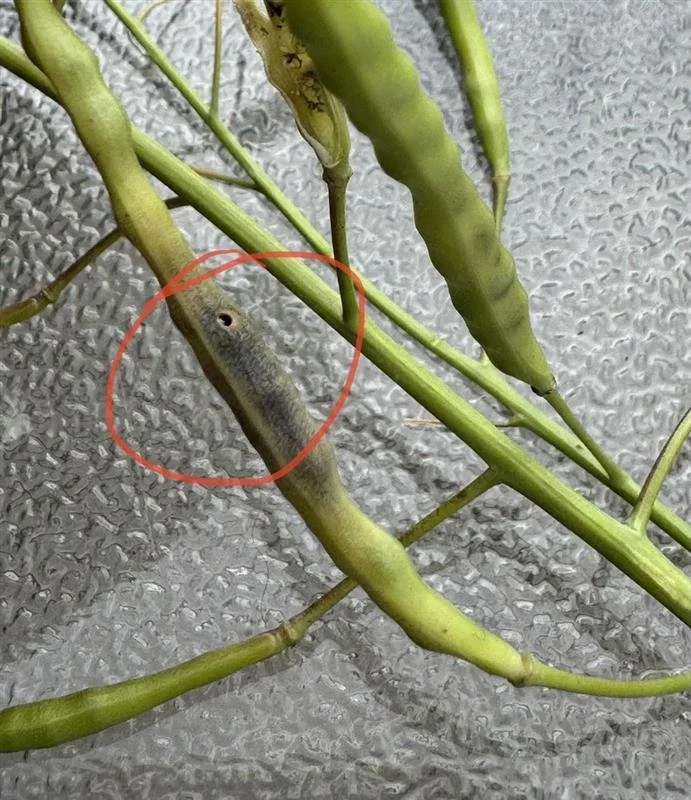
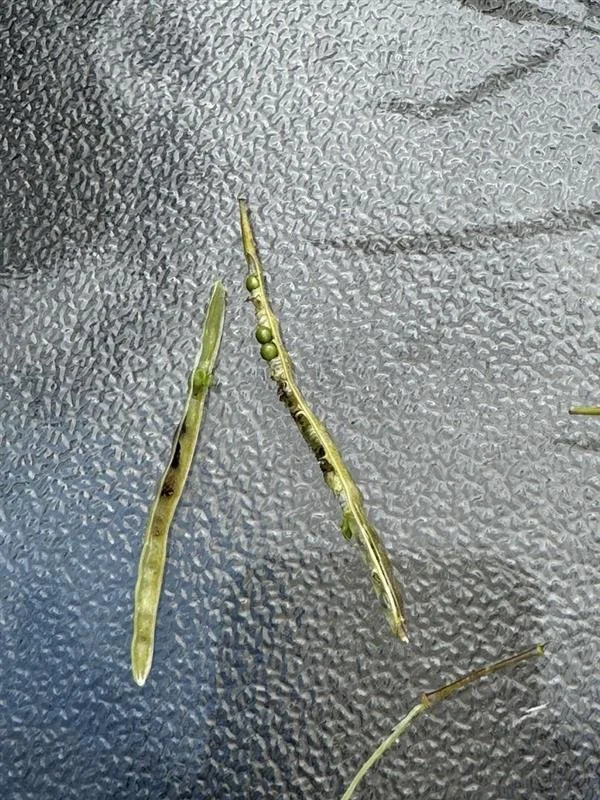
The exit hole, and potentially some darkening of the pod due to fungal infection – is what we are looking for when doing a follow up scout.
We may still very likely see some damage in small amounts throughout a field due to differences in pest and crop timing – but important to take note if there is significant damage showing on our plants. Pressure would likely be highest at field edges, or near ditches/treelines where populations would have been higher.
This follow-up scouting can also help us evaluate the effectiveness and timing of an application. Did we see a positive response? Is there anything we would adjust about application timing next year? Alternatively, in fields that did not require an application, what did the final crop look like? These observations help us connect what we saw during our initial counts and scouting, to what ultimately happened this season.
Looking Ahead
Seedpod weevil management doesn't end with the spray pass in crop year ‘26. The observations we make now and afterwards, from pod damage to field-to-field differences, will help us better understand how populations translate into damage, and can help to build our approach and confidence heading into future seasons.
As we come to the close of this growing season, the goal isn't to have all the answers. It's to take what this season taught us into the next one: scout carefully, make informed decisions, follow up, and keep building on what we learn in the field.
-Breanna Miller
Check out these helpful links:
Purchasing-sweepnet-factsheet.pdf
Monitoring-with-sweepnet-factsheet-april2026.pdf