
Best Management Practices for Cabbage Seedpod Weevil in Canadian Canola
Cabbage seedpod weevil has primarily been limited to the Southern Alberta region of Western Canada’s canola acres for decades. Today, however, Manitoba canola growers are becoming increasingly familiar with this insect as populations continue to expand eastward across the Prairies.
Several factors may have contributed to the increased prevalence of this new economic threat to Manitoba canola production.
Increased Canola Acres
Large, continuous expanses of canola provide abundant food and reproductive habitat, allowing populations to build from year to year.
Earlier Seeding
Earlier-seeded canola often flowers before neighbouring fields, making it highly attractive to migrating adults. Research consistently shows the first flowering fields receive the highest infestations.
Winter Survival
Although severe winters can reduce survival, adults are well insulated beneath snow. Even modest overwintering success can result in large populations because a single female may lay approximately 300 eggs during the season.
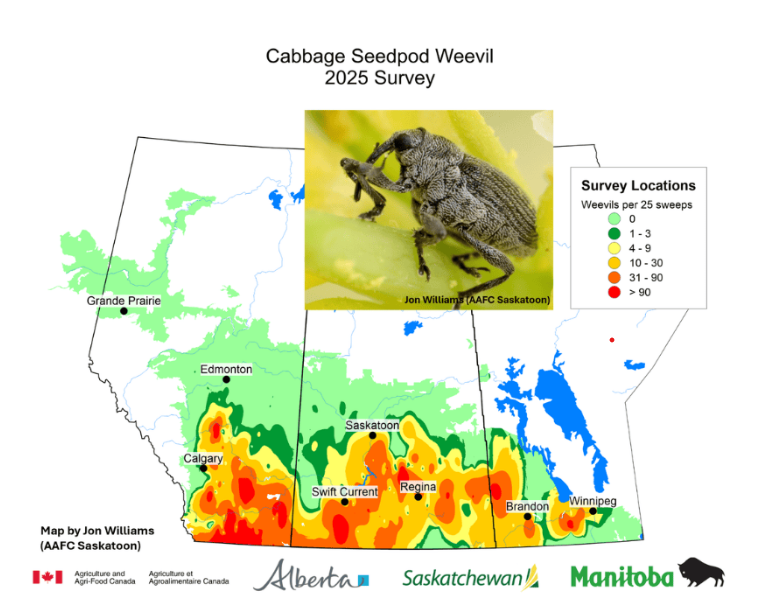
Year-to-year weather and overwinter survival can shift these boundaries considerably.
Adult cabbage seedpod weevils are small, ash-grey beetles approximately 3–4 mm long with a characteristic curved snout. Adults overwinter beneath leaf litter, shelterbelts and field margins before emerging in spring as temperatures warm.
The adults feed on flower buds, stems and blossoms, but this feeding causes relatively little economic damage. The real yield loss occurs after females lay eggs inside newly developing pods.
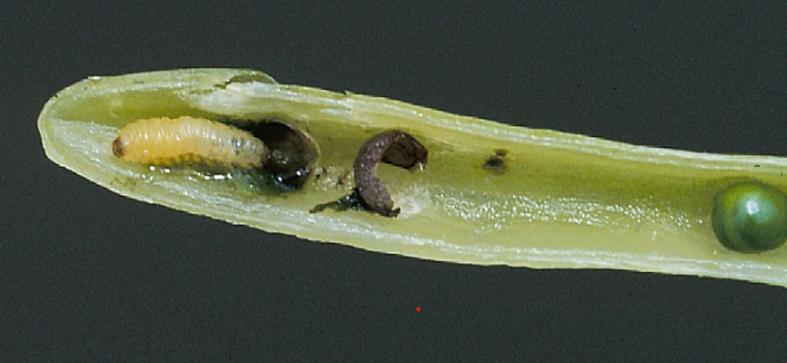
Each female deposits one egg per pod. After hatching, larvae feed on developing seeds before chewing an exit hole through the pod wall to pupate in the soil. The exit hole allows secondary feeding by other insects and increases pod shattering before harvest.
The good news is that cabbage seedpod weevil can be effectively managed through careful scouting, proper timing and an integrated pest management approach that protects both yield, beneficial insects, and pollinators.
Scouting
Recommended scouting includes:
Scout as crop begins to flower
Sample at least four locations throughout the field
Include both field edges and interior
Use a standard sweep net
Complete ten 180-degree sweeps at each location
Sample during warm, calm conditions when adults are most active
Scout earlier-seeded fields more frequently
Current economic thresholds are:
25–40 adult weevils per 10 sweep-net samples
Field edges often contain much higher numbers than field centres because adults invade from the outside inward. This creates opportunities for perimeter only treatments in some situations.
Spray Timing
The ideal spray window occurs when canola reaches 10–20% flowering.
By this stage:
Adults have largely migrated into the field
Pods are beginning to form
Eggs have not yet been widely deposited
Spraying earlier may require a second application as additional adults continue arriving.
Spraying later allows egg laying to occur and reduces economic returns while increasing insecticide exposure of pollinators and beneficial insects.
Protecting Pollinators
Canola benefits tremendously from insect pollination.
Research has shown pollinators can increase canola yield by 10–15%, while also improving seed set and quality. Consequently, unnecessary insecticide applications can reduce both pollinator populations and crop productivity.
When insecticide applications are necessary:
Avoid spraying during peak daytime pollinator activity.
Consider perimeter applications when infestations are concentrated along field edges.
As cabbage seedpod weevil populations continue expanding across Manitoba it will be important to avoid routine, blanket insecticide applications and focus on integrated pest management practices to provide control.
~Andrew Johnston