
Hybrids Don’t Flex Up…They Flex DOWN
Whether you’re an experienced corn grower or planning for your first corn crop in 2026, understanding one detail can take your management to the next level. That detail is the ear-type of your chosen variety.
There Are 3 Ear Types That Categorize Corn Hybrids: Fixed-ear, Semi-Flex ear, and Flex-Ear. These categories describe how a hybrid will react when exposed to environmental stress. Hybrid’s do not create yield potential as the season progresses – they will start with top yield potential and lose yield as they grow through their environment.
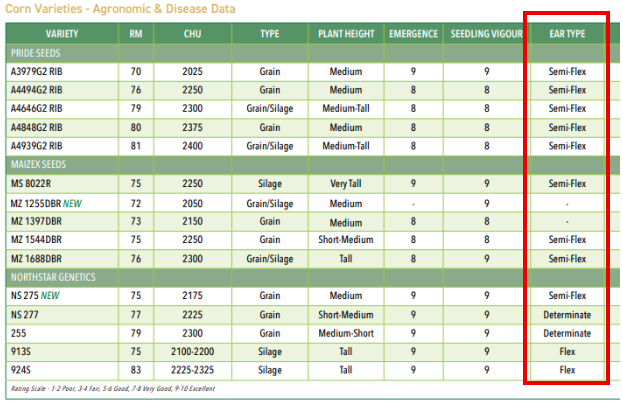
Understanding Hybrid Flex helps you match your management strategies to maximize the capabilities of your favorite hybrid. One ear-type is not necessarily better or higher yielding than the other.
3 components of Hybrid Flex:
When does it flex?
a. Ear Girth – determined in early vegetative stages (V2-6)
b. Ear Length – determined during flowering (V8-VT/R1)
c. Kernel Mass – determined during grain-fill (R1-R6)
How much will it flex/how sensitive is it to stress?
What stressors cause it to flex? Ex: high population, temperature, moisture availability.
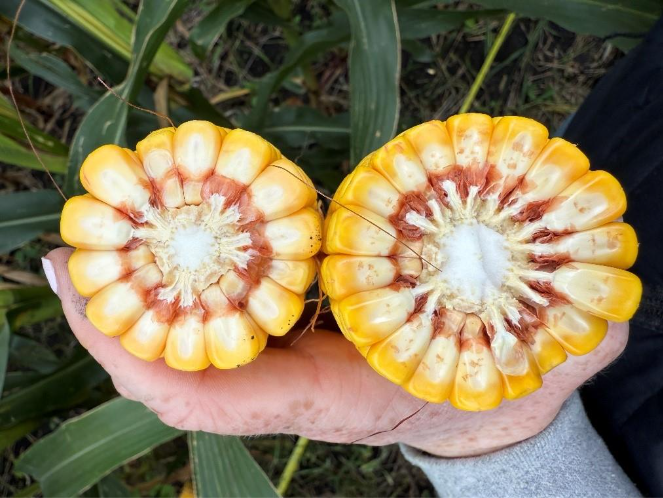
Image 1: Left: 78 day, competitor variety, Semi-fixed ear. Right: 77 day, NS 277 from Northstar Genetics, Determinate/Fixed ear.
Why Do We Care About This?
Because we don’t know what the environment is going to give us. If we could predict the season/supply the crop with everything it needs – we would always pick a Fixed/Determinate hybrid.
When we are thinking about management of flex or fixed-ear hybrids, we are primarily thinking about population management. In an environment where all other factors are the same, a flex hybrid will lose yield as populations increase whereas fixed ear hybrids will maintain yield as populations increase.
So, when is a flex-hybrid an advantage? Corn Hybrids with the most flex are used in tougher situations because they are a little more yield stable.
A really good example is described in a Case Study video from Real Agriculture with Ken Ferrie:
For example: A grower has well-drained soil, good early season moisture through May - June, but has risk of average to below average rainfall during grain-fill. What traits should he select for in his hybrid?
Avoid hybrids that flex in depth. Kernel Mass flex will occur during the last 30 days of grain-fill. Lack of water during this time will cause a yield hit to kernel mass hybrids. Select a hybrid that sets its yield based on kernel count and depth of kernel isn’t likely to change.
Pick a hybrid that can shine with low populations (ie Flex-ear hybrid)– lower populations reduce competition for resources like water.
The statement, “Hybrids don’t flex up, they flex down” helps growers understand that it is important to determine a hybrids weaknesses – these are the components growers will need to manage to capture as much yield potential as possible.
~Katie Meggison