
Wet Fall, Busy Spring
A lot of farmers were hoping to apply Nitrogen in the fall and did accomplish due to wet conditions. Whether you normally band ammonia or broadcast and incorporate urea, it was too wet for many to accomplish their normal fall fertilizer routine. In turn, it will be a busy fertilizer season this spring.
What Do You Plan This Spring?
After completing a soil test, we know how much Nitrogen next year’s crop needs to reach yield goals. With the price per pound of Nitrogen increasing year over year, efficiently utilizing every pound applied to the soil is crucial to increasing profitability. Time will be the essence this spring, the fastest way to get those pounds across acres this spring would be a broadcast application without any incorporation. It is important to realize the risk of Nitrogen loss through broadcast applications when not incorporated.
Risks With Broadcast Applications:
Banking on a rain to incorporate your broadcast application can be risky. Products such as ESN, Super U or Urea treated with Agrotain are designed to improve Nitrogen use efficiency and reduce volatilization losses. This may sound like the answer for a fast broadcast application this spring. Although these products can help reduce Nitrogen losses, it is important to remember they are not a substitution for incorporation. This can be even more costly to an operation paying a premium for fertilizer and not utilizing every pound applied.
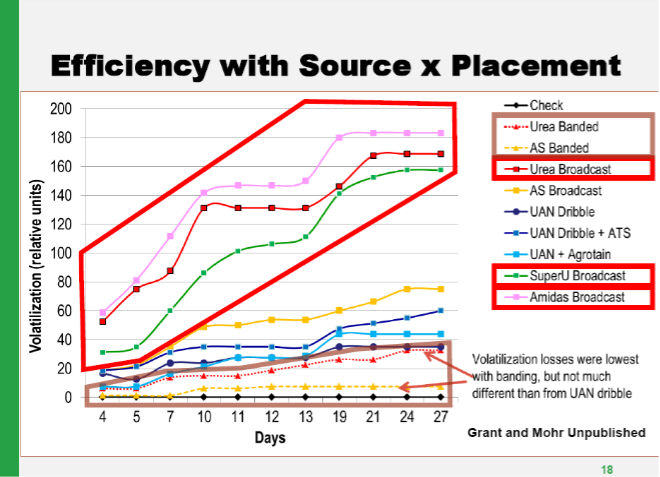
If you are planning to broadcast a product this spring, do you plan to incorporate the application, and how many pounds do you plan to apply through broadcast? A broadcast application without any incorporation is at high risk for Nitrogen loss. Limiting the risk of nitrogen loss through a broadcast application is important.
Can’t Avoid Broadcast Applications?
If you won’t be able to avoid broadcasting applications this spring, how can you minimize the amount of product broadcasted? Unlike Nitrogen, nutrients such as Phosphorus, Sulphur or Potassium can carry some residuals from year to year. Sulphur and Phosphorus have strong residuals due to their low mobility in the soil.
Heavy clay soil around the Pitura Farm and Red River Valley tend to have high Potassium levels (average 240 ppm Province of Manitoba | agriculture - Manitoba Fertilizer Recommendation Guidelines Based on Soil Tests). This may be a year to consider using some of that Potassium bank and maximizing the capacity to incorporate some more Nitrogen. Specialty products like ESN allow you to place 3 times as much seed placed nitrogen as urea without damaging seed (ESN: The Nitrogen Fertilizer For Seed Safety | Smart Talk).
If you are set up with mid-row bands, maximize the Nitrogen pounds placed mid row to avoid or minimize broadcast Nitrogen. If you are set up to top dress corn up to the v8 stage, increasing the pounds of nitrogen incorporated through a top dress application can work to replace some broadcasted pounds and help limit nitrogen loss.
In conclusion, there are many products and methods of application out there to get your crop the nutrition it needs to thrive. Focusing on your 4 R’s will guide you to the right decision for your operation.
~Derek Keddie