Iron Deficiency Chlorosis: Looking Beyond the Yellow
As soybeans enter first to third trifoliate you may start to notice Iron Deficiency Chlorosis (IDC). IDC tolerance is a driving factor when deciding on your soybean variety. When symptoms of IDC prevail, you will notice yellow leaves with green leaf veins (interveinal chlorosis). Usually, we see IDC in new leaves as the plant is no longer able to mobilize iron. Iron is unable to translocate through the plant therefore unifoliate leaves usually remain green. Even though we chose the variety with the highest IDC rating, and soil tests show we have adequate soil iron, why are we still seeing IDC?
Why do we experience IDC
Soil tests in Manitoba generally show high iron content. IDC is not a result of low soil iron; it is a result of soil conditions that limit iron uptake by soybean roots. Soil carbonate content and salinity are primarily related to the risk and severity of soybean IDC. High carbonate and salinity tie up iron in the soil, limiting uptake by soybean roots. Typically, across a field you see IDC hot spots focused on areas of the field with high carbonate and salinity. Soil with excess phosphorus can also experience IDC as phosphorus can tie up plant available Iron. Another factor affecting IDC that we are experiencing this growing season is cool, wet soil. These factors increase the chances of neutralizing the soil acidity which decreases the uptake of iron by soybean roots. PH can be an indicator of soybean IDC risk but do not just focus on soil PH, typically high PH soils have high carbonate and salinity levels, but there are high PH soils that lack high carbonate and salinity. Due to the small particle size and tight packing in heavy clay soils, they often have poor aeration. Iron availability can be negatively affected by low oxygen levels. Poor aeration can lead to a buildup of carbon dioxide in the soil which can also reduce iron availability.
How do we prevent IDC
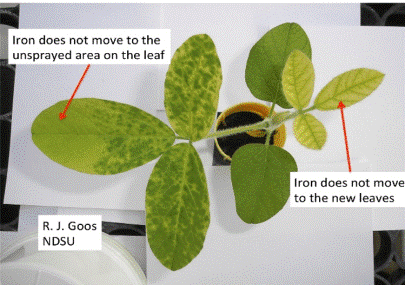
In season rescue options for IDC are limited, waiting for the plants to recover on their own is the most common practice. Foliar applications in crops may have shown short term cosmetic effects, but there is no data showing an increase in yield with foliar application as iron is unable to translocate within the plant. The picture below shows a soybean plant with a foliar Iron application.
The best way of preventing soybean IDC is by looking at long-term control methods. The obvious being selecting the variety that has the best IDC tolerance. Management practices reducing residual phosphorus can help reduce iron tied up in the soil, cover cropping can help reduce residual phosphorus. Banding phosphorus near the seed row, instead of broadcasting, can help reduce iron tied up by phosphorus. Cover cropping can also help reduce carbonates and soil salinity as well as build organic matter to help with soil aeration. Even though PH is not a primary factor for IDC, working to lower your soil PH can also help reduce IDC. This is because as PH increases plants have a tougher time taking up Iron even if it isn’t tied up with other nutrients. Another option to consider is chelate iron fertilizers in your fertilizer application. Chelated iron is in a form that stops it from being tied up with other nutrients and remains plant available. Essentially providing a protective layer for your iron to stop it from being tied up in the soil.
In conclusion, IDC management is an ongoing process and not a one-time fix. Focusing on long term soil health is key to reducing IDC experiences. With soil carbonate and salinity levels being the primary factors affecting IDC.
~Derek Keddie